Facilitation Techniques in Therapeutic Recreation 4th ed - eBook
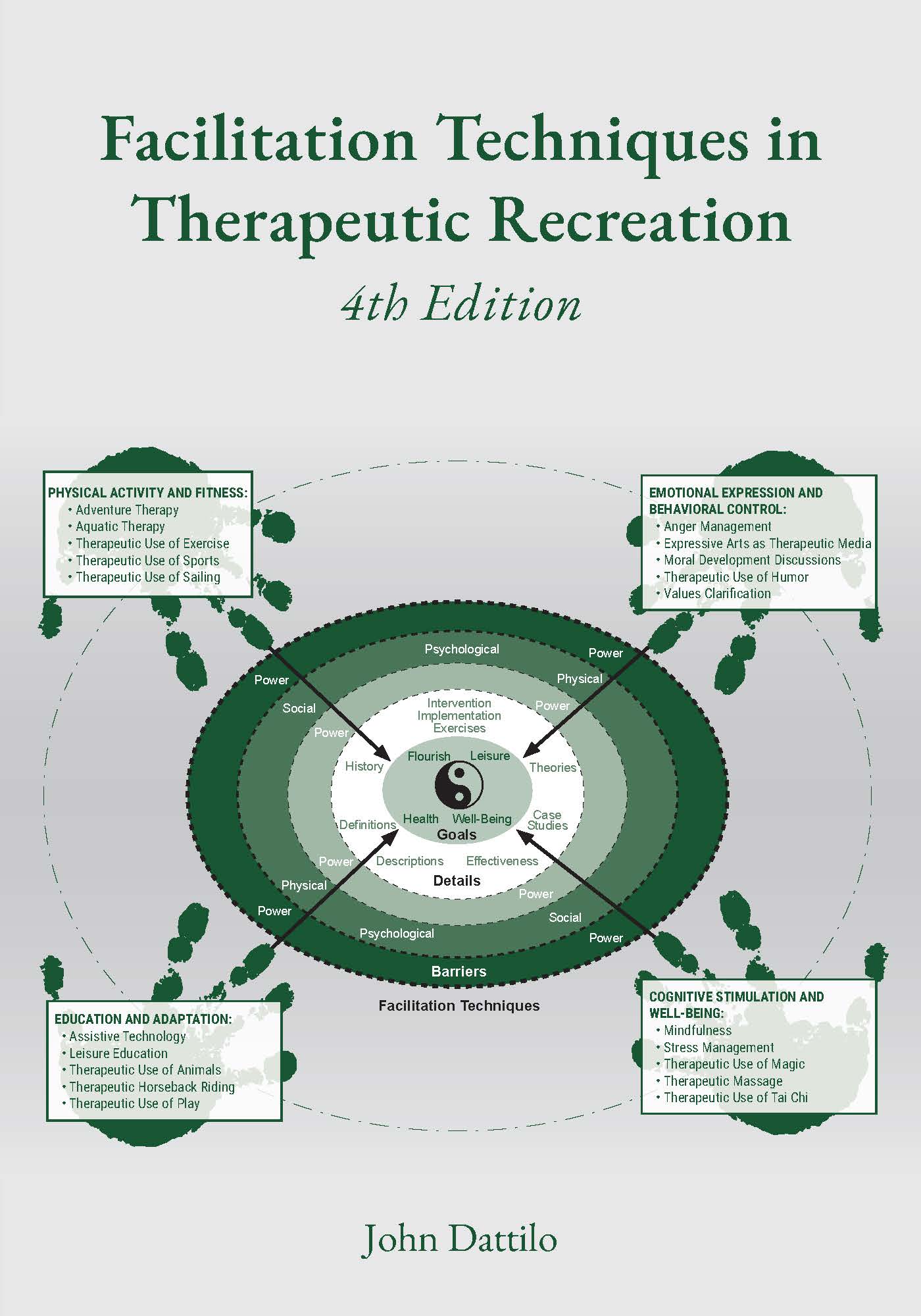
The model on the book cover depicts a way to categorize various facilitation techniques. The model identifies the “Goals” of therapeutic recreation to achieve psychological and physical health and well-being and to ensure people experience leisure and flourish as highlighted in the center circle. As indicated in the “Details” section in the middle of the model, a way to increase understanding of techniques contained in this book is to provide information about: definitions of terms, descriptions of programs documented in the literature, history of techniques, theories describing and supporting their use, research examining their effectiveness, case studies demonstrating their use, and engaging in intervention implementation exercises.
We use therapeutic recreation facilitation techniques to reduce people’s leisure “Barriers” associated with power, psychological perspectives, social conditions, or physical contexts indicated by the darker circles. Since power is a result of human interactions involving active engagement in social networks that involve discourse occurring anywhere in which people make choices, some contexts might result from people experiencing freedom and well-being while engaged in leisure; however, barriers occur in other situations when leisure ties with experiences of exclusion, suffering, and discrimination. Also, many people experience sociological barriers involving negative attitudes associated with stigmatization and alienation that limit their ability to experience leisure and play. Psychological barriers prevent various people from experiencing subjective well-being that strongly connects to leisure. People also encounter physical challenges to experiencing leisure associated with access, such as accessibility of travel services and tourism.
The “Facilitation Techniques” in this book cluster into four major areas located in the stars on the four corners of the model. Several techniques focus on education an adaptation including leisure education, use of assistive technology, therapeutic use of animals and play, as well as therapeutic horseback riding. There are also techniques concentrating on physical activity and fitness such as adventure and aquatic therapy as well as therapeutic use of exercise, sports, and sailing. A third area, emotional expression and behavioral control, includes anger management, expressive arts as therapeutic media, moral development discussions, therapeutic use of humor, and values clarification. Finally, there are techniques focused on cognitive stimulation and well-being including mindfulness, stress management, and therapeutic massage, as well as therapeutic use of magic and tai chi. Application of therapeutic recreation facilitation techniques allows us to help participants achieve their desired goals.
Original: $72.00
-65%$72.00
$25.20Product Information
Product Information
Shipping & Returns
Shipping & Returns
Description
The model on the book cover depicts a way to categorize various facilitation techniques. The model identifies the “Goals” of therapeutic recreation to achieve psychological and physical health and well-being and to ensure people experience leisure and flourish as highlighted in the center circle. As indicated in the “Details” section in the middle of the model, a way to increase understanding of techniques contained in this book is to provide information about: definitions of terms, descriptions of programs documented in the literature, history of techniques, theories describing and supporting their use, research examining their effectiveness, case studies demonstrating their use, and engaging in intervention implementation exercises.
We use therapeutic recreation facilitation techniques to reduce people’s leisure “Barriers” associated with power, psychological perspectives, social conditions, or physical contexts indicated by the darker circles. Since power is a result of human interactions involving active engagement in social networks that involve discourse occurring anywhere in which people make choices, some contexts might result from people experiencing freedom and well-being while engaged in leisure; however, barriers occur in other situations when leisure ties with experiences of exclusion, suffering, and discrimination. Also, many people experience sociological barriers involving negative attitudes associated with stigmatization and alienation that limit their ability to experience leisure and play. Psychological barriers prevent various people from experiencing subjective well-being that strongly connects to leisure. People also encounter physical challenges to experiencing leisure associated with access, such as accessibility of travel services and tourism.
The “Facilitation Techniques” in this book cluster into four major areas located in the stars on the four corners of the model. Several techniques focus on education an adaptation including leisure education, use of assistive technology, therapeutic use of animals and play, as well as therapeutic horseback riding. There are also techniques concentrating on physical activity and fitness such as adventure and aquatic therapy as well as therapeutic use of exercise, sports, and sailing. A third area, emotional expression and behavioral control, includes anger management, expressive arts as therapeutic media, moral development discussions, therapeutic use of humor, and values clarification. Finally, there are techniques focused on cognitive stimulation and well-being including mindfulness, stress management, and therapeutic massage, as well as therapeutic use of magic and tai chi. Application of therapeutic recreation facilitation techniques allows us to help participants achieve their desired goals.